
Social media for estate agents: why are your posts not bringing in valuations?
Last updated: 5 October 2026 · By CodiePi Limited
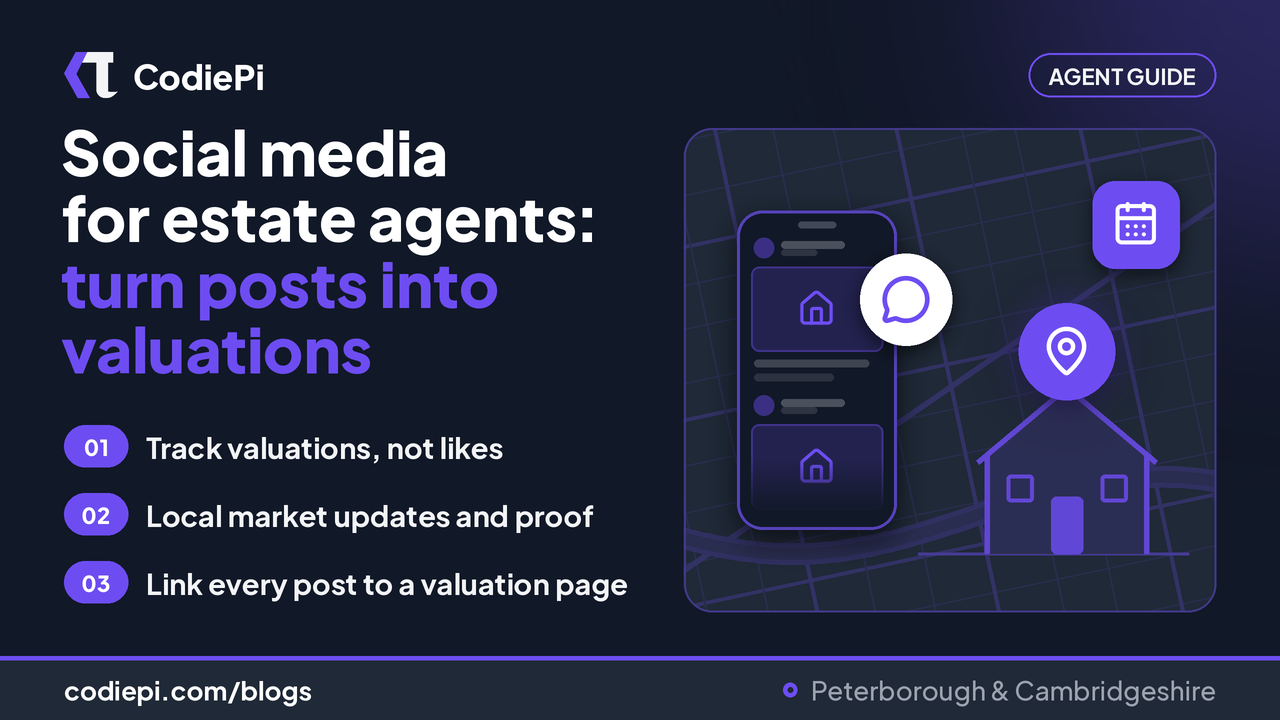
Social media for estate agents brings in valuations when every post has a job and a way to measure it. Post for homeowners in your patch, not only buyers: homes you have sold or let nearby, local market updates and short videos with your team. Link each post to a valuation page on your own website, tag the link with UTM parameters so Google Analytics shows which post sent the visit, and record every valuation enquiry by source. Repeat your best updates as Google Business Profile posts. Then judge the work on valuations booked, not likes.
In this guide
- Why are your social media posts not bringing in valuations?
- Who should estate agent posts be for?
- What should you post to win valuations?
- How do you track valuations, not likes?
- Why should every post link to a valuation page?
- How do Google Business Profile posts fit in?
- What rules apply to property posts on social media?
- Should you pay to boost posts?
- How much time should a small agency give social media?
- How does CodiePi approach social media for estate agents?

Photo on Pexels
Why are your social media posts not bringing in valuations?
Most agency feeds are a stream of new listings with "book a valuation" added at the end, and nobody checks whether a post ever led to an instruction. With portal bills rising and the market slowing, social media for estate agents now has to show what it brings in.
In a 26 September 2026 column for Estate Agent Today, property commentator Jonathan Rolande warned that agents face being busier and poorer at the same time as asking prices fall. He named social media likes as something that may help one day but won't pay this year's bills.
Portal costs add to the squeeze. Agents told BBC News in April that Rightmove fees had become unsustainable, some saying their bill had more than doubled, while admitting the portal still brings most of their leads. The Negotiator reported a small-town independent warning that its latest renewal put the business at risk, and an agent in an older r/HousingUK thread reported a rise of about a sixth. Rightmove says it is confident in the value it provides to agents.
US agents on forums say the same: pick one or two platforms, post consistently and measure appointments, not likes.
Who should estate agent posts be for?
Your fee comes from instructions, so the most valuable followers are local homeowners who might sell or let in the next year or two, not only buyers browsing stock. Social media for estate agents is one of the few places a homeowner can watch you work before calling.
Zoopla's 2025 seller research, reported by Estate Agent Today, found the most common deciding factor when sellers chose an agent was a good local presence, with the agent already selling other homes nearby. Around half said they would invite three agents to value before choosing. Regular posts are a cheap way to show that presence week after week, so you make the list of three.

Photo on Pexels
What should you post to win valuations?
Post local market updates and proof that you sell and let homes nearby. Sold and let homes, honest answers and quick videos with your valuer all show homeowners you know their street. Listings still belong on your feed, but they shouldn't be the only thing there.
Posts that give homeowners a reason to remember you
- Sold and let nearby: a photo and a line about the street or type of home, with your client's permission.
- Local market updates: what is coming to market and selling in your area, using your own figures or published data you link to.
- Seller and landlord questions: one question per post, such as what to fix before a valuation.
- Faces and process: a short phone video with the person who does your valuations, with captions so it works on mute.
- Your valuation offer: a regular, plain post explaining what a valuation involves, linking to the booking page.
One market update with real local detail beats five generic graphics. Good social media for estate agents sounds like a person who knows the area, not a brochure.
How do you track valuations, not likes?
Give every link you share a UTM tag, send it to a page on your own site and count what happens next. Likes and reach show attention. Clicks show interest. Valuation enquiries, valuations attended and instructions won show money. Review those three figures each month by platform, and drop any type of post that never moves them.
Google Analytics' guidance on UTM parameters explains that adding utm_source, utm_medium and utm_campaign to a link shows which campaign sent each visit. Google recommends lowercase, consistent names and a separate source for each platform. An Instagram link might end ?utm_source=instagram&utm_medium=social&utm_campaign=valuations.
A homeowner may see a post, then search your name days later, so the UTM report will undercount social. Ask every valuation enquiry how they heard about you and record the answer in your CRM.

Photo on Pexels
| What you measure | What it tells you | How to use it |
|---|---|---|
| Likes, comments and reach | Whether people notice the post | Useful for testing content, not for judging spend |
| Link clicks (UTM sessions) | Whether a post sends people to your site | Compare post types and platforms |
| Valuation enquiries by source | Whether visits turn into requests | Your main monthly social figure |
| Valuations attended | Whether enquiries are real sellers or landlords | Spot channels that send time-wasters |
| Instructions won | What social media actually earns you | Decide where time and budget go |
Based on Google Analytics campaign reports and your CRM; no benchmarks implied.
Why should every post link to a valuation page?
A homepage full of listings sends a curious homeowner in five directions. A dedicated valuation page has one job: explain what a valuation involves, show local proof and make booking easy on a phone. When every social link points there, you can see what each post produced.
Keep the page simple: a short form, a phone number someone answers, what happens after booking, recent homes sold or let nearby, and genuine reviews. Lettings agents can run a matching landlord page; our guide to what a lettings agent website should show covers that side.
If you add a social media pixel to retarget visitors, sort out consent first. ICO guidance says you must get consent for social media tracking technologies, whether or not visitors use that network, and advertising uses can't rely on any exception. If your site can't support a page like this, our web design service in Peterborough builds them.
How do Google Business Profile posts fit in?
Google Business Profile posts are the partner to social media for estate agents: they put your updates in front of people already looking at your agency on Search and Maps. Share the same proof there, such as a recent sale or a market update, with a button linking to your valuation page.
Google's help page on Business Profile posts says updates can include a photo or video and an action button with a link, and that posts older than six months are archived unless a date range is set. It also warns that posts containing a phone number may be rejected if the number can't be verified, so let the button do that job. Tag button links with UTMs too. Our guide to Google Business Profile for Peterborough estate agents covers the profile itself.
What rules apply to property posts on social media?
Social media for estate agents counts as marketing when posts are about your services or properties, so advertising and consumer protection rules apply. Keep claims accurate, give the key facts about a property or link straight to them, and for lettings in England, state a specific rent. This is general guidance, not legal advice.
The ASA explains that the CAP Code covers material on a company's own social media channels when it is directly connected to its goods or services. Its guidance on brand-owned social media says posts on your own clearly named account are generally recognisable as advertising without an extra "Ad" label.
Property posts are property adverts. Propertymark reported in May 2025 that National Trading Standards had withdrawn its material information guidance, after the Digital Markets, Competition and Consumers Act 2024 replaced the regulations behind it, but key facts must still be presented clearly. On a short post, give the price and main facts, then link to the full listing.
For lettings in England, the Renters' Rights Act 2025 changed adverts from 1 May 2026. GOV.UK's rental bidding guidance lists a social media post as a written advert, which must state a specific rent, not a range, and agents must not invite, encourage or accept offers above it.
Should you pay to boost posts?
Paid social media for estate agents can put your valuation offer in front of homeowners in a set area, not only existing followers, but it needs the same discipline as organic posts. Set a small test budget, send clicks to your valuation page with UTM tags, and judge it on valuation enquiries and instructions, not cost per click.
Start by boosting posts that already earned enquiries, keep targeting to the postcodes you cover, and stop anything that brings clicks but no enquiries after a fair test. We don't quote typical costs per lead, because they vary by area and budget. Our comparison of SEO and Google Ads explains how paid search fits alongside.
How much time should a small agency give social media?
Less than you might fear, if the time goes on the right posts. A small independent can run social media for estate agents as a weekly routine: two or three posts that show local proof, one Google Business Profile update and a monthly look at enquiry sources.
A simple weekly routine
- Monday: post a home you sold or let nearby, with permission, linking to your valuation page.
- Wednesday: share a short local market update or answer one seller or landlord question.
- Friday: post a short video answering a question you heard this week.
- Once a week: repeat your best update as a Google Business Profile post with a booking button.
- Once a month: compare enquiries, valuations and instructions by source, and drop what isn't working.
Reply to comments quickly. A question in the comments can become a valuation; a like never will.
How does CodiePi approach social media for estate agents?
We treat social media as one part of a measured lead system, not a one-off post calendar. That means a valuation page on your site, UTM-tagged links on every post, a Google Business Profile that matches, and a monthly report showing enquiries and valuations by source, so you can see what each channel earns.
Scope is agreed in writing before we start. We don't promise follower numbers, valuations or instructions, because those depend on your area, your competitors and how quickly your team follows up. Our guide to choosing a digital marketing agency lists the questions to ask any supplier, including us.
CodiePi is based at 11 Carpenters Way, Doddington, March PE15 0RZ, and works with agents in Peterborough, across Cambridgeshire and beyond. We have no city-centre office. Our own posts are on Instagram at @codiepi.ltd.
See our digital marketing services for how social media for estate agents fits with search and paid campaigns. To talk through your feed and your valuation page, book a free call.
Social media for estate agents: FAQs
Which social media platform is best for estate agents?
There is no single best platform for every agency. Start with the one or two where homeowners in your area follow local businesses and your team can post every week. Test each with UTM-tagged links to your valuation page, then keep the platforms that produce valuation enquiries and drop the ones that only produce likes.
How often should an estate agent post on social media?
Often enough to stay visible, and no more often than you can keep up with useful local posts. Two or three good posts a week plus a weekly Google Business Profile update is a realistic start for a small team. There is no official magic number, so judge frequency by enquiries, not by how busy the feed looks.
Can social media really generate valuation leads?
Yes, but usually not straight away. Many homeowners who follow you are not selling this month, so social media for estate agents works by keeping your name in front of them until they are. Posts that link to a valuation page, quick replies to messages and a tracked enquiry form turn that attention into valuations you can count.
Do estate agents need to label their own social posts as ads?
Usually not, when the post is on your own clearly named agency account. ASA guidance says a brand's posts on its own social media accounts are generally recognisable as advertising, so an extra "Ad" label is unlikely to be needed. The CAP Code still applies to what you say, and content you pay someone else to post is treated differently.
Should lettings agents use social media differently?
Lettings agents can follow the same plan, with landlords as the main audience instead of sellers. Show lets you have handled, explain rule changes plainly and link to a landlord page. In England, under the Renters' Rights Act 2025, a social media post advertising a let must state a specific rent, and you must not invite, encourage or accept offers above it.
Sources
- Estate Agent Today, Three rules for surviving a falling market (Jonathan Rolande, 26 September 2026): https://www.estateagenttoday.co.uk/features/2026/09/three-rules-for-surviving-a-falling-market/
- BBC News, Estate agents accuse Rightmove of charging excessive fees (1 April 2026): https://www.bbc.co.uk/news/articles/cn0yle5rrp8o
- The Negotiator, 'We are at risk of going out of business because of Rightmove', agent tells The Neg (4 February 2026): https://thenegotiator.co.uk/news/marketing-news/we-are-at-risk-of-going-out-of-business-because-of-rightmove-agent-tells-the-neg/
- Reddit r/HousingUK, "Agents: How much did Rightmove raise your price?" (forum thread): https://www.reddit.com/r/HousingUK/comments/1cy2d57/agents_how_much_did_rightmove_raise_your_price/
- Reddit r/realtors, "Is posting listing flyers and videos on social media actually worth doing?" (US forum thread): https://www.reddit.com/r/realtors/comments/1sy4h8o/is_posting_listing_flyers_and_videos_on_social/
- Reddit r/realestateagents, "New solo agent: what social media is actually worth the time?" (US forum thread): https://www.reddit.com/r/realestateagents/comments/1ta2mwu/new_solo_agent_what_social_media_is_actually/
- Estate Agent Today, Sellers care more about local presence than price, Zoopla claims (5 August 2025): https://www.estateagenttoday.co.uk/breaking-news/2025/08/sellers-care-more-about-local-presence-than-price-zoopla-claims/
- Google Analytics Help, URL builders: Collect campaign data with custom URLs: https://support.google.com/analytics/answer/10917952
- ICO, Guidance on the use of storage and access technologies: What are the exceptions?: https://ico.org.uk/for-organisations/direct-marketing-and-privacy-and-electronic-communications/guidance-on-the-use-of-storage-and-access-technologies/what-are-the-exceptions/
- Google Business Profile Help, Create and manage posts on your Business Profile: https://support.google.com/business/answer/7342169
- ASA, Remit: Social media: https://www.asa.org.uk/advice-online/remit-social-media.html
- ASA, Recognising ads: Brand-owned and paid social media: https://www.asa.org.uk/advice-online/recognising-ads-brand-owned-and-paid-social-media.html
- Propertymark, Material Information guidance withdrawn as the Digital Markets, Competition and Consumers Act takes over: https://www.propertymark.co.uk/resource/material-information-guidance-withdrawn-as-the-digital-markets-competition-and-consumers-act-takes-over.html
- GOV.UK, Assured periodic tenancies: a guide for landlords: Rental bidding: https://www.gov.uk/assured-tenancy-agreements-a-guide-for-landlords/rental-bidding