
Website design for plumbers: what should your site do to win more local jobs?
Last updated: 4 October 2026 · By CodiePi Limited
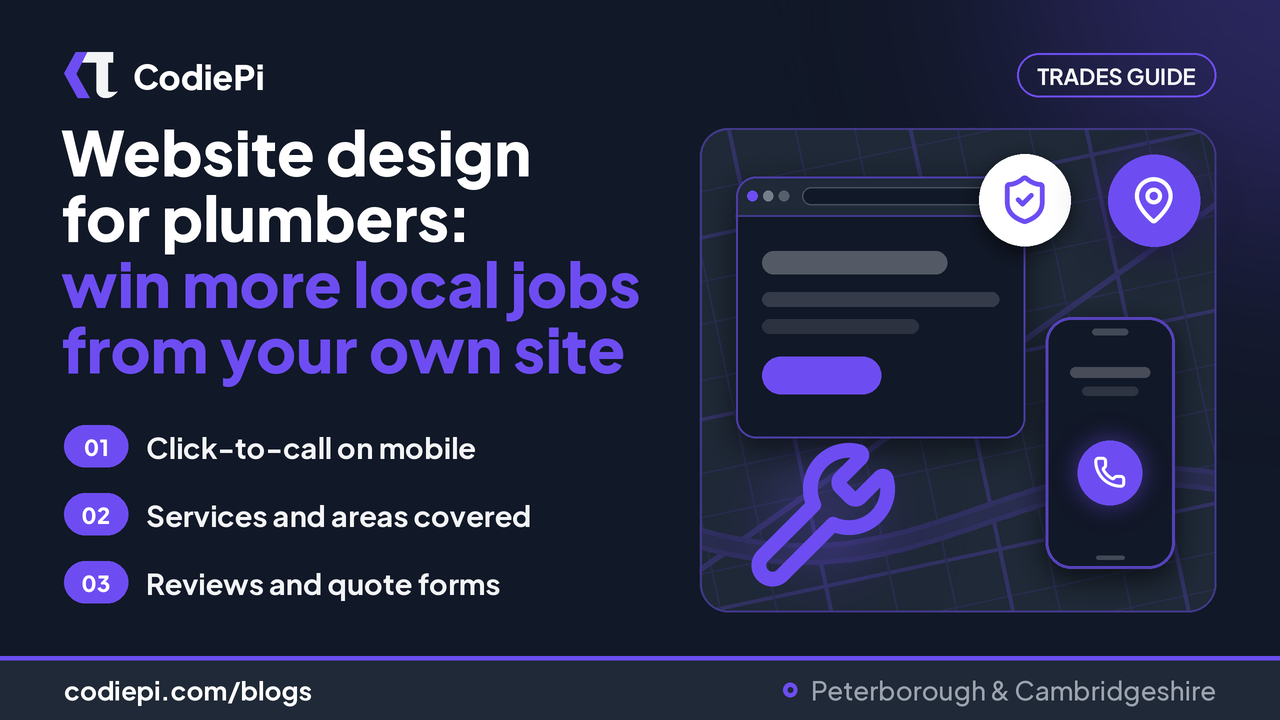
Website design for plumbers comes down to one job: turning a local search into a phone call or quote request that comes to you alone. A good plumber website loads fast on a phone and puts a tap-to-call button at the top of every page. It lists each service and the towns you cover, shows your Gas Safe registration if you do gas work, links to genuine Google reviews and offers a short quote form. Connect it to your Google Business Profile so the two point the same way. Built like this, a site gives you work you own, rather than renting leads that may also go to other trades.
In this guide
- Why are plumbers looking beyond paid lead platforms?
- What pages does a plumber website need?
- How should you show Gas Safe registration on your site?
- Why do click-to-call and a mobile layout matter so much?
- How should reviews and quote forms work on a plumbing website?
- How does your website work with your Google Business Profile?
- How fast should a plumber website load?
- What does a website cost compared with paying for leads?
- How does CodiePi approach website design for plumbers?
Photo on Pexels
Why are plumbers looking beyond paid lead platforms?
Many plumbers and electricians say paid lead platforms have become harder to justify. In trade forums, some report rising fees, 12-month contracts, capped leads and enquiries sent to several firms at once. A website and Google profile you control won't replace every lead overnight, but nobody else is sold the enquiries they bring in.
In one r/ukplumbing discussion about Checkatrade, a plumber thinking of joining describes a monthly fee with a 12-month commitment. A long-standing member says their renewal price had climbed a long way, that leads are now capped, and that they are building up their Google profile so they can leave.
On r/ukelectricians, one electrician says the platform offered a few leads a month on a 12-month contract, with each lead also offered to three other firms. In another thread, a sole trader says the ranking favoured firms with more reviews.
These are individual experiences, not survey data, and some tradespeople say platforms still help when starting out. But paying to join a race for a job is different from a customer finding you and ringing you directly. Good website design for plumbers is built around that second route.
What pages does a plumber website need?
Good website design for plumbers starts with the right pages: a home page, one page per main service, an areas covered page, a clear emergency callout section if you offer it, an about page with your registrations, and a contact page with phone, form and hours. Each page should answer one type of search.
Start with the jobs you want more of. Boiler servicing, leak repairs, blocked drains and emergency callouts are different searches, so give each its own page that says what you do, where, and how to book.
Pages most plumbing websites need
- Home page: what you do, where you work, your phone number and Gas Safe details above the fold.
- Service pages: one for each main job, written in plain words a homeowner would use.
- Areas covered: the towns and postcodes you serve. A Peterborough plumber might list Peterborough, Whittlesey, March and Yaxley, but only places you really cover.
- Emergency callout: your actual hours and response approach, with no promises you can't keep.
- About and contact: who does the work, your registrations, photos of real jobs, a phone link and a short form.
Prices are your call; see the FAQ below.
How should you show Gas Safe registration on your site?
If you do gas work, we recommend showing your business's Gas Safe registration number clearly, for example in the header or footer and on your about page. In Great Britain, businesses doing domestic gas work must be on the Gas Safe Register, and householders are told to check an engineer before work starts.
HSE's Approved Code of Practice L56 explains that gas businesses must belong to a class of persons approved by HSE, and that Gas Safe Register is the body with that approval. Gas Safe Register's ID card guidance says every registered engineer carries an ID card with a unique licence number, and its 2012 guide to the Register advises customers to ask for the card and check the engineer is qualified for the job before any gas work.
Good website design for plumbers makes that check easy. Add your registration number, a line inviting customers to check you on the Gas Safe Register website, and the types of gas work you are qualified for. Use your business registration number, not an engineer's ID card licence number, which changes each time a new card is issued. If you don't do gas work, say so.
Logos need care. Gas Safe Register's Brand Enforcement Policy says only registered businesses may display the Gas Safe brand or a Gas Safe registration number, and only alongside the trading name on the Register. Guidance on Business Companion says the Digital Markets, Competition and Consumers Act 2024 bans displaying a trust mark or quality mark without authorisation, and it names the Gas Safe logo as one to take particular care with. Remove the logo and number as soon as your registration lapses.

Photo on Pexels
Why do click-to-call and a mobile layout matter so much?
Many people looking for a plumber are standing next to the problem with a phone in hand. Click-to-call on mobile means your number is a button they can tap from any page, not text they have to copy. If the layout makes them pinch and zoom to find it, they will go back and ring someone else.
In website design for plumbers, the call button belongs in a sticky header or footer that stays visible as people scroll. Use a real tel: link so it dials straight away, plus a quote form button for people who can't talk at work.
Check it on your own phone, and an older one. Text should be readable without zooming, buttons big enough for a thumb and forms short enough to finish standing up.
For emergency work, show your real hours next to the button rather than a 24/7 claim you can't staff.
How should reviews and quote forms work on a plumbing website?
Reviews and quote forms turn a visitor into an enquiry. Show genuine Google reviews, linked back to your profile so customers can check them, and ask every happy customer to leave one. Keep the quote form short: name, phone, postcode, job type and an optional photo upload.
Only use real reviews on websites for plumbers. Google's Maps content policy bans fake engagement and says businesses must not offer incentives, such as discounts or free services, in exchange for reviews. The CMA's guidance on unfair commercial practices covers the UK rules on fake reviews.
The simplest habit is a review link sent by text once the job is done. Reply to reviews too, calmly and briefly.
On the form, ask only what you need to call back. A photo of the leak saves a wasted visit. Say how quickly you reply, and send enquiries to a phone you actually check.
How does your website work with your Google Business Profile?
Your Google Business Profile is often the first thing a local customer sees, and website design for plumbers should treat the two as one system. Link the profile to your site, use the same business name, phone number and service area on both, and make sure the services on your profile match the service pages on your site.
Google's local ranking guidance says local results are mainly based on relevance, distance and popularity, and that replying to reviews can help your business stand out.
If you work from home, set a service area rather than showing your house address. Google's Business Profile guidelines give exactly this example: a plumber running the business from a home address should clear the address and use a service area. Our guide to local SEO and Google Business Profile in Peterborough walks through the set-up step by step.
Results from a new site and a tidy profile build over months, as we explain in how long SEO takes for Peterborough businesses. If you want help with that side, see our SEO services in Peterborough.

Photo on Pexels
How fast should a plumber website load?
Fast enough that a customer on mobile data sees your name and phone button straight away. Speed is part of website design for plumbers, not an extra. Google's Core Web Vitals give clear targets: the main content should load within 2.5 seconds, the page should respond to taps within 200 milliseconds, and the layout shouldn't jump about as it loads.
Those thresholds come from web.dev's Core Web Vitals guide. Slow websites for plumbers usually share the same causes: huge photos straight off a phone, heavy page builders, sliders and too many plug-ins. Compress images, cut what doesn't help a customer book, and choose decent hosting.
What does a website cost compared with paying for leads?
A website is usually a build cost plus ongoing hosting and upkeep, while lead platforms charge a fee for as long as you stay. The right comparison isn't the price of a lead. It is the cost of each job you actually win, and who owns the customer afterwards.
We won't quote typical prices, because they vary by scope. Our guide to website costs for Peterborough businesses breaks down what drives the price. If you already have an old site, read whether a new website is still worth it in 2026 before you replace it.
| Question | Your own website and Google profile | Paid lead platform |
|---|---|---|
| Who gets the enquiry? | Only you | May be sent to several trades, some tradespeople report |
| How do you pay? | Build cost, then hosting and upkeep | Ongoing fee; terms vary by platform and plan |
| Contract length | Set by you and your web provider | Some tradespeople report 12-month contracts |
| What happens if you stop paying? | The site and reviews stay yours | The listing and lead flow stop |
| Where do reviews live? | On your Google profile, linked from your site | On the platform's profile |
| How fast does it work? | Builds over months, alongside SEO | Can bring enquiries quickly |
Sources: trade forum threads listed below. Platform terms change, so check current terms with any provider.
Plenty of plumbers use both for a while. Record where each paid job came from, then decide at renewal time with real numbers.
How does CodiePi approach website design for plumbers?
Our plumbing website design starts with the jobs you want more of and the area you really cover, then builds the site around a phone call. That means a call button on every page, service and area pages written in plain English, your Gas Safe details where customers expect them, and a Google profile that matches.
Scope is agreed in writing before we start. We don't promise rankings, call numbers or a cost per job, because those depend on your area, your competitors and how quickly you answer the phone.
CodiePi is based at 11 Carpenters Way, Doddington, March PE15 0RZ, and we work with trades across Peterborough and the rest of Cambridgeshire. We have no city-centre office.
See our web design service in Peterborough for how website design for plumbers projects run. If you'd like a straight answer on what your site needs, book a free call and tell us the jobs and towns you want to win.
Website design for plumbers: FAQs
Do plumbers really need a website if they have a Google Business Profile?
A profile on its own can bring calls, but a website gives Google and customers more to go on. It holds your service pages, areas covered, Gas Safe details, photos and quote form, and backs up your profile. It is also the one place online you fully control, whatever happens to any platform or listing.
Should I put prices on my plumbing website?
That is your decision. Some plumbers show their own "from" prices for standard jobs like a boiler service, which helps filter enquiries. Others prefer to quote after seeing the job. If you show prices, keep them current and explain what can change the final figure, such as parts, access or out-of-hours work. Plumbing website design should make either approach easy to update.
Can I use the Gas Safe logo on my website?
Yes, if your business is on the Gas Safe Register. Registration includes a licence to use the Gas Safe brand under its brand guidelines, but only with the trading name on the Register. Trading Standards guidance says displaying a trust mark without authorisation is banned under the Digital Markets, Competition and Consumers Act 2024, and it names the Gas Safe logo as one to take particular care with. Show your registration number too, so customers can check you on the register before booking.
How long does a new plumber website take to bring in work?
Some enquiries can come quickly from people who already know your name or find your Google profile. Ranking for wider searches such as "plumber in Peterborough" usually takes months, depending on competition, reviews and how complete your pages are. Keep existing lead sources until the numbers show you can drop them.
Is website design for plumbers different from other trades?
The basics of website design for plumbers apply to any local trade: fast mobile pages, a clear call button, service and area pages, and genuine reviews. Plumbers add Gas Safe details for gas work, emergency callout information and photo uploads on quote forms. Electricians and builders can follow the same plan with their own registrations.
Sources
- Reddit r/ukplumbing, "Checkatrade?" (trade forum thread, accessed 3 Oct 2026): https://www.reddit.com/r/ukplumbing/comments/1ta2762/checkatrade/
- Reddit r/ukelectricians, thread on paid lead costs and contract terms (trade forum thread, accessed 3 Oct 2026): https://www.reddit.com/r/ukelectricians/comments/1j4emrs/checkatrade_wanting_150_a_month_for_4_leads/
- Reddit r/ukelectricians, "checkatrade?" (trade forum thread, accessed 3 Oct 2026): https://www.reddit.com/r/ukelectricians/comments/1tof74j/checkatrade/
- Health and Safety Executive, L56 Safety in the installation and use of gas systems and appliances (Approved Code of Practice): https://www.hse.gov.uk/pubns/priced/l56.pdf
- Gas Safe Register, A guide to Gas Safe Register (2012): https://www.gassaferegister.co.uk/media/1448/overview-of-gas-safe-register.pdf
- Gas Safe Register, What is the Gas Safe ID card?: https://www.gassaferegister.co.uk/gas-safety/the-gas-safe-id-card/
- Gas Safe Register, Brand Enforcement Policy (v10, February 2026): https://www.gassaferegister.co.uk/media/qaeh0ntx/p001_bep001-brand-enforcement-policy-v10-final.pdf
- Health and Safety Executive, Check an engineer: are they Gas Safe registered?: https://www.hse.gov.uk/gas/gas-safe-register-check.htm
- Business Companion (Trading Standards), Membership logos and claims of approval: https://www.businesscompanion.info/en/quick-guides/fair-trading/membership-logos-and-claims-of-approval
- Google Maps, Prohibited and restricted content (Maps user contributed content policy): https://support.google.com/contributionpolicy/answer/7400114
- Competition and Markets Authority, Unfair commercial practices (CMA207, updated 18 November 2025): https://www.gov.uk/government/publications/unfair-commercial-practices-cma207
- Google Business Profile Help, Tips to improve your local ranking on Google: https://support.google.com/business/answer/7091
- Google Business Profile Help, Guidelines for representing your business on Google: https://support.google.com/business/answer/3038177
- web.dev, Web Vitals: https://web.dev/articles/vitals