
Facebook ads for estate agents: why are your ads getting likes but no valuations?
Last updated: 20 October 2026 · By CodiePi Limited
Facebook ads for estate agents win valuations when they run as lead campaigns, not boosted posts. Declare Meta's housing Special Ad Category, make one clear valuation offer, send clicks to a short landing page or a higher intent form, call every lead back quickly and record which leads book a valuation and then instruct you.
In this guide
- Why ads get likes, not valuations
- The housing Special Ad Category
- Who you can reach
- Your valuation offer
- Lead forms or a landing page
- Creative that works
- Budget
- Tracking leads to valuations
- How CodiePi helps

Photo on Pexels
Why do Facebook ads for estate agents get likes but no valuations?
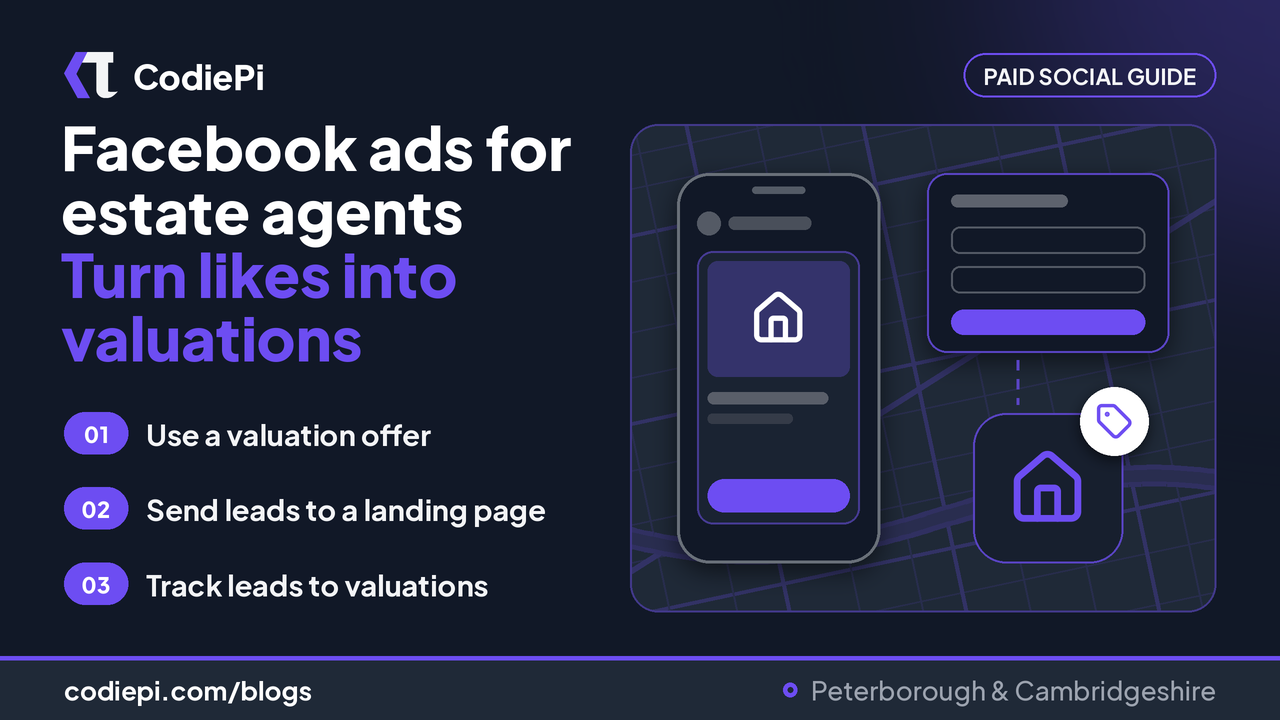
Usually because they were set up to win attention. A boosted post or an engagement campaign looks for people likely to react, comment or watch, and Meta delivers exactly that. Homeowners about to sell are a small slice of any local feed, so the ad needs a lead objective, a real offer and a way to count what happens next.
Meta's own guide to choosing an ad objective is plain about it. The Engagement objective finds people likely to interact with your ad or Page. The Leads objective collects leads through messages, phone calls or sign-ups. When you boost a post, you can let Facebook choose the goal for you, and a goal chosen for you is rarely "valuation booked".
The audience is also smaller than it looks. Propertymark's Housing Insight Report for July 2026 puts the average member branch at 75 new buyer registrations that month against 24 market appraisals. Buyers and browsers happily like property posts. Far fewer people in your town are about to invite an agent round.
The usual leaks in Facebook ads for estate agents:
- Wrong objective: engagement or reach campaigns that report likes, shares and video views.
- No housing category: ads rejected because the Special Ad Category was not declared.
- Easy forms: a default form anyone can send in two taps, so the list fills with people who were only curious.
- No follow-up record: leads sit in a download folder and nobody knows which became valuations.
Do UK estate agents have to use Meta's housing Special Ad Category?
In most cases, yes. Meta's housing rules apply when your audience is in the United Kingdom, and its definition of a housing ad covers sale and rental listings, appraisal services and real estate services. A valuation offer or landlord campaign from an estate agent fits that description, so declare the housing category when you create the campaign.
Meta's page about ads for housing lists the United Kingdom among the places where advertisers must choose a Special Ad Category, and warns that ads may be rejected if they don't. Tips about home buying and education about housing rights fall outside the definition. An ad inviting homeowners to book a valuation is not a tip.
Once you declare it, Meta's audience rules for housing apply:
- Age and gender: fixed at 18 to 65+ and all genders.
- Location: countries, regions, counties, towns or cities, but not postcodes, and you can't exclude locations.
- Radius: Meta's Help Centre says UK audiences based on a town, address or pin include a 10 mile (17 km) radius, so check the area Ads Manager shows before you publish.
- Detailed targeting: some demographic, behaviour and interest options are unavailable, and exclusions are switched off.
- Lookalikes: Advantage+ lookalike audiences are unavailable.
Boosted posts are covered too. Meta's boost settings include a Special Ad Category switch for housing, so the rules follow the ad, not the button you pressed. This is general guidance, not legal advice.
Who can you reach under Meta's housing rules?
Facebook ads for estate agents can reach people in the towns you cover, people who have visited your website and people who already know your agency. You can't pick a postcode, an age group or a "likely to move" segment. Under the housing rules, your offer and your copy do most of the targeting, because the settings can't.
Start with geography. Choose the towns where you actually sell and let, accept the wider radius Meta adds around each one, and only split ad sets where the message changes, such as a town where you have recent sales to show.
Next, people who know you. Meta notes that custom audiences may only be available in Ads Manager, so build valuation campaigns there rather than from the boost button. People who read your valuation page are often the warmest audience you have, but reaching them again depends on consent, which we cover under tracking.
Then let the copy choose its own audience. Lines such as "Book a valuation in Wisbech" or "Letting a house in Whittlesey? Get a rental valuation" mean little to a buyer and a lot to an owner. The right people pick themselves out.
What valuation offer should Facebook ads for estate agents make?
Make one offer, say exactly what the homeowner gets and keep it true. An in-person valuation by a named valuer, a rental valuation for landlords or a short local market report can all work. Whichever you choose, the ad, the form and the follow-up call should describe the same thing.
The offer is what turns a scroll into a lead. Common choices:
- In-person valuation: the strongest intent, because the homeowner is inviting you round.
- Online estimate, then a visit: easier to request, but call it an estimate and say a valuer will be in touch.
- Rental valuation: for landlords, with a line on what your managed and let-only services include. Our guide to what a lettings agent website should show covers the landlord page behind it.
- Local market report: a softer offer for owners not ready yet, which feeds your database rather than your diary.
Be careful with "free". The ASA's guidance on the use of free says ads must not call something free if people pay anything beyond the unavoidable cost of responding (CAP Code rule 3.23), and must make clear the extent of any commitment needed to get it (rule 3.24). A valuation with no fee and no obligation to instruct you can be called free, so say exactly that.
Should Facebook ads for estate agents use lead forms or a landing page?
For most small agencies, send valuation clicks to a short landing page on your own website. It can show local proof, explain what happens next, ask for the property address and keep the data in your own systems. Instant forms bring in more leads for less effort, but they need tighter filtering and faster calls.
Meta offers three instant form types. The default, More volume, is designed to make sending the form quick on mobile and to generate more leads. Higher intent adds a line saying the business may follow up and a review screen to confirm details, which Meta says helps prevent submissions from people who are only marginally interested. Higher intent forms only appear in Facebook and Instagram feeds on mobile.
| Route | What the homeowner sees | Strengths | Watch out for |
|---|---|---|---|
| More volume instant form | A prefilled form inside Facebook or Instagram | Quick to send, quick to set up | Curious submissions, details not checked |
| Higher intent instant form | A prefilled form with a review screen | Fewer casual submissions, optional phone check | Mobile feeds only, fewer leads |
| Landing page on your website | Your own valuation page with local proof | More context, your branding, data in your systems | Slower to fill in, pixel needs consent |
If you use forms, use the filters. Meta's instant form guide lists custom questions and conditional logic, so you can ask whether the person owns the property and when they might move. Meta's phone number verification sends a one-time code by text, and anyone who enters a landline can't submit. Every form also needs a link to your privacy policy.
If you use a landing page, give it one job. We explain how to build that valuation page, and tag each link by channel, in our guide to social media for estate agents. Facebook ads for estate agents need that page even more than organic posts do, because every click costs money.

Photo on Pexels
What creative works in Facebook property ads?
Ads that look and sound local. Photos of streets and homes you have sold or let, used with the owner's permission, a short video of your valuer explaining what a valuation involves, and copy that names the town. Polished stock graphics and vague "best agent in town" lines tend to disappear into the feed.
A few things that help:
- Local proof: a recent sale or let nearby, named by street or area rather than full address.
- A face and a voice: a short phone video with captions, because plenty of people scroll with the sound off.
- One message per ad: a sales valuation, a landlord service or a market report, not all three at once.
- Claims you can back up: our guide to Google Ads for estate agents explains why the ASA reads "number one" agent claims as sales claims that need evidence.
In a small area the same people will see your ads again and again. Refresh the image and the opening line every few weeks so the ad doesn't become wallpaper.
How much should estate agents spend on Facebook ads?
There is no honest fixed figure, because costs depend on your area, competition, season and creative. Start with a monthly test budget you could afford to lose, run it long enough to collect a fair number of leads, then judge it on cost per valuation booked and instructions won, not cost per lead.
Before you spend anything, decide what a booked valuation is worth to your agency. Multiply your average fee by the share of valuations that become instructions, and you have the most a booked valuation can cost before the ads stop paying for themselves. Your own figures tell you far more about whether Facebook ads for estate agents are paying off than a benchmark from somewhere else.
Start small: one area, one offer, one form or page. Change one thing at a time and give each change a few weeks, because results in a small town move slowly. If leads still aren't becoming valuations after a fair test, pause and fix the offer, the form or the follow-up before you spend more.
How do you track Facebook ads for estate agents through to valuations?
Give every lead a source, a status and an outcome. Tag landing page links with UTM parameters, export or sync instant form leads every day, and record in your CRM whether each lead was contacted, booked a valuation, was valued and instructed you. Then compare campaigns on valuations and instructions, not form fills.
Leads don't wait for you. Meta keeps instant form leads available to download for up to 90 days from submission and recommends downloading often or using a CRM. A lead nobody exported is a lead you have lost.
For landing pages, the Meta Pixel and the Conversions API report form submissions back to Meta. The pixel needs consent first. The ICO's guidance on online advertising says storage and access technologies used for advertising, and the tracking linked to them, need consent, and measuring the ads falls under that same consent. Check your cookie banner covers it before you switch it on.
Meta can also learn from your CRM. Its Conversions API for CRM guide explains how sending lead stages back lets the Conversion Leads goal look for people more likely to convert, but it suggests at least 200 leads a month and daily uploads. Most independent agencies won't reach that, so a simple record reviewed weekly does the job:
| Stage | What to record | Why it matters |
|---|---|---|
| Lead | Date, campaign, ad, name and property address | Shows which ad produced it |
| Contacted | Time of first call and the outcome | Slow follow-up loses leads |
| Valuation booked | Date and valuer | The number to judge the ads on |
| Valued | Attended or cancelled | Shows lead quality |
| Instructed | Sale or let, and the fee | Shows what the ads earned |

Photo on Pexels
How does CodiePi help with Facebook ads for estate agents?
We look at the whole route from ad to instruction, not only the ads. That means the housing category set correctly, one clear valuation offer, a landing page or filtered form, consent-ready tracking and a monthly report on valuations booked by campaign, so you can see what each pound spent actually produced.
Our free audit shows how your agency appears online, the main issues costing you enquiries and how you compare with local competitors, with nothing to pay. Through our digital marketing services we can set up and manage paid social alongside search and email. We won't promise a cost per lead, valuations or instructions, because those depend on your area, your offer and how quickly your team calls back.
CodiePi Limited is based at 11 Carpenters Way, Doddington, March PE15 0RZ. We have no city-centre office and work with agencies across Peterborough, Cambridgeshire and the rest of the UK, mostly online and by phone. Find us on Instagram at @codiepi.ltd, or book a free call.
Facebook ads for estate agents: FAQs
Are Facebook ads worth it for estate agents?
Facebook ads for estate agents can pay off if you run them as lead campaigns with a clear valuation offer and track what happens after each lead. Facebook puts you in front of homeowners before they start searching, which search ads can't do. Judge a fair test on valuations booked and instructions won, and fix the offer, form or follow-up before raising the budget.
Do valuation ads count as housing ads on Facebook?
Meta's definition of a housing ad includes appraisal services and real estate services, as well as sale and rental listings. A valuation offer from an estate agent fits that wording, so declare the housing Special Ad Category whenever your audience is in the UK. Meta warns that ads which should carry the category but don't may be rejected.
Can I target homeowners or people likely to move on Facebook?
Not directly under the housing rules. You can't set age, gender or postcode, you can't exclude areas and some interest and behaviour options are unavailable. Target the towns you cover, use website visitor audiences where people have consented, and write copy that speaks to owners and landlords so the right people choose to respond.
Should I boost posts or use Ads Manager?
Use Ads Manager for valuation campaigns. It lets you choose the Leads objective, pick a form type, add qualifying questions and build custom audiences, which Meta says may only be available there. Boosting can spread a good organic post further, but it rarely produces valuation leads on its own. Both routes need the housing category declared.
How quickly should we call back a Facebook lead?
As soon as you can, and the same working day at the latest. Someone who tapped a prefilled form may not remember your agency's name a few days later. Send alerts to a named person, log the time of first contact, and download or sync leads daily, because Meta only keeps them available to download for 90 days.
Sources
- Meta Business Help Centre, How to choose the right ad objective in Meta Ads Manager: https://www.facebook.com/business/help/1438417719786914
- Meta Business Help Centre, Boost a post from your Facebook Page: https://www.facebook.com/business/help/347839548598012
- Propertymark, Housing Insight Report: July 2026 (published 16 September 2026): https://www.propertymark.co.uk/resource/housing-insight-report-july-2026.html
- Meta Business Help Centre, About ads for housing: https://www.facebook.com/business/help/1198401317374558
- Meta Business Help Centre, About audiences for housing, employment or financial products and services campaigns: https://www.facebook.com/business/help/2220749868045706
- ASA, Use of "free" (AdviceOnline): https://www.asa.org.uk/advice-online/use-of-free.html
- Meta Business Help Centre, About instant form types: https://www.facebook.com/business/help/252352181957512
- Meta Business Help Centre, About lead ads with instant form: https://www.facebook.com/business/help/761812391313386
- Meta Business Help Centre, Enable the SMS verification feature to help improve lead quality: https://www.facebook.com/business/help/898260175547909
- Meta Business Help Centre, About expired leads: https://www.facebook.com/business/help/1526849577619206
- Meta Business Help Centre, About Conversions API: https://www.facebook.com/business/help/2041148702652965
- ICO, How do the rules apply to online advertising? (guidance on the use of storage and access technologies): https://ico.org.uk/for-organisations/direct-marketing-and-privacy-and-electronic-communications/guidance-on-the-use-of-storage-and-access-technologies/how-do-the-rules-apply-to-online-advertising/
- Meta for Developers, Conversions API for CRM integration (updated 17 December 2025): https://developers.facebook.com/docs/marketing-api/conversions-api/conversion-leads-integration