
SEO for bathroom fitters: why do the big showrooms get the calls you should be getting?
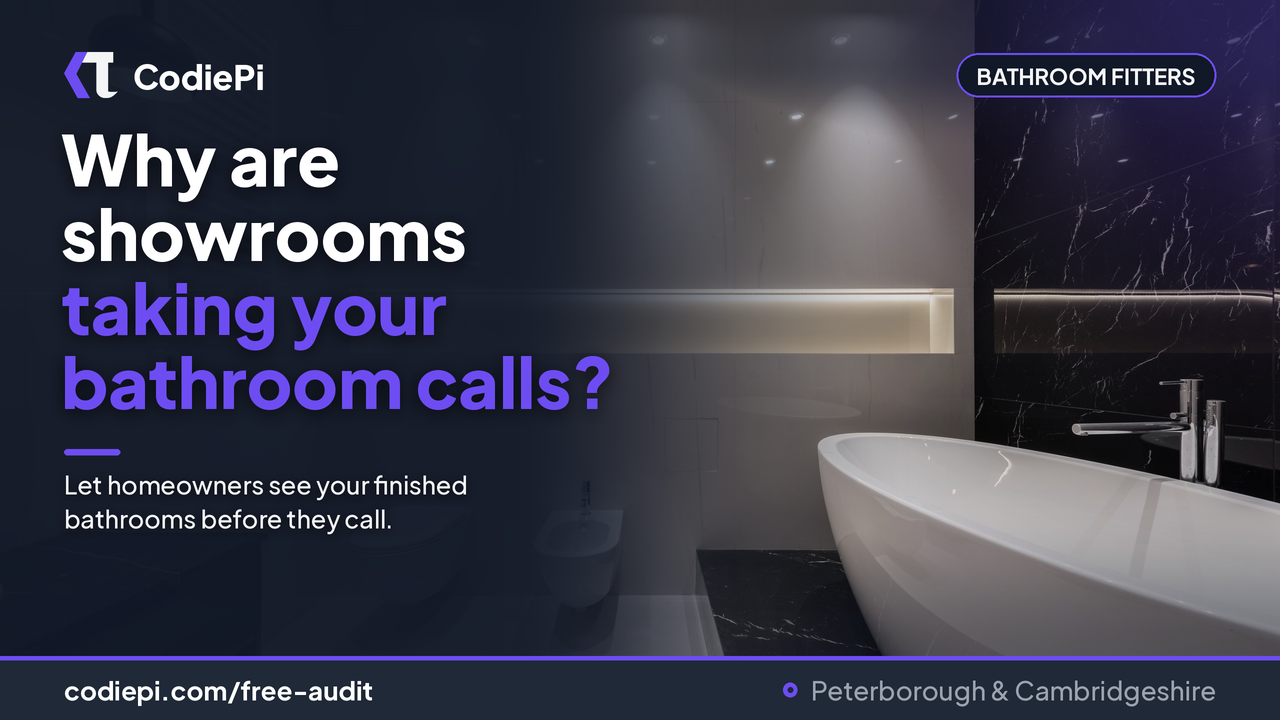
Last updated: 24 November 2026 · By CodiePi Limited
SEO for bathroom fitters works when your website shows Google the specific jobs you do and the towns you do them in. Showrooms and lead-generation sites win because they have a page for every product, style and location. A skilled independent can compete with real project pages for each job type and town.
Our guide to marketing for kitchen fitters covers Business Profile setup, galleries, reviews and trust marks for both kitchen and bathroom trades. This post goes deeper into the website itself. It is for bathroom fitters who do excellent work but find showrooms, national brands and quote-comparison sites above them for the searches that matter.
In this guide
- Why do showrooms and lead-gen sites outrank independent bathroom fitters?
- What is a project page, and why does it beat a gallery?
- Which job types deserve their own page?
- How do you build town pages without creating doorway pages?
- How should a bathroom fitter write titles, headings and image text?
- How do internal links help a small trade website rank?
- Which approach suits which kind of bathroom business?
- What should a bathroom fitter fix first?
- How does CodiePi help bathroom fitters with SEO?

Photo by Vladimir Srajber on Pexels
Why do showrooms and lead-gen sites outrank independent bathroom fitters?
Because they give Google far more relevant pages to choose from. A showroom has a page for every suite, shower and tile range. A lead-gen site has a page for every trade in every town. An independent fitter may only have a homepage, a services page and a gallery, so there is simply less to match against the search.
Google's SEO starter guide says that creating content people find compelling and useful will likely influence your presence in search results more than any of its other suggestions. Large sites aren't winning because they are large. They are winning because their pages answer specific searches, even if the answers are thin.
That is the opening for a skilled fitter. A lead-gen page can say little about the actual work. They can't show your wet room in a particular village or explain how you dealt with an awkward soil stack. Specific, first-hand pages are something they can't easily copy.
The other factor is the Maps pack. Google ranks local results on relevance, distance and prominence. Your website feeds relevance, so better pages help you there too. SEO for bathroom fitters is mostly about turning the work you already do into pages Google can find.
What is a project page, and why does it beat a gallery?
A project page is a single page about one finished job: the room, the town, what the customer wanted, what you did and before and after photos. A gallery is a grid of images with little text. Google can read a project page and match it to searches; a grid of photos gives it little.
Google's image SEO guidance says it extracts information about an image from the page content, including captions, and recommends placing images near relevant text. It adds that descriptive filenames give light clues too. A project page does all of that naturally. A slider of fifty photos with names like IMG0042 does none of it.
A useful project page covers:
- The type of job, such as a full bathroom refit, a wet room or a walk-in shower conversion.
- The town or area, if the customer is happy for you to name it.
- The brief in a sentence or two: what the customer wanted and why.
- What you did, including anything tricky, in plain language.
- Before, during and after photos you took yourself, with descriptive alt text.
- How long the job took, if you're comfortable sharing it.
Project pages are the core of SEO for bathroom fitters. Write each one while the job is fresh. Two or three short paragraphs and a handful of photos are enough. Over a year, those pages build into proof that no showroom brochure can match.
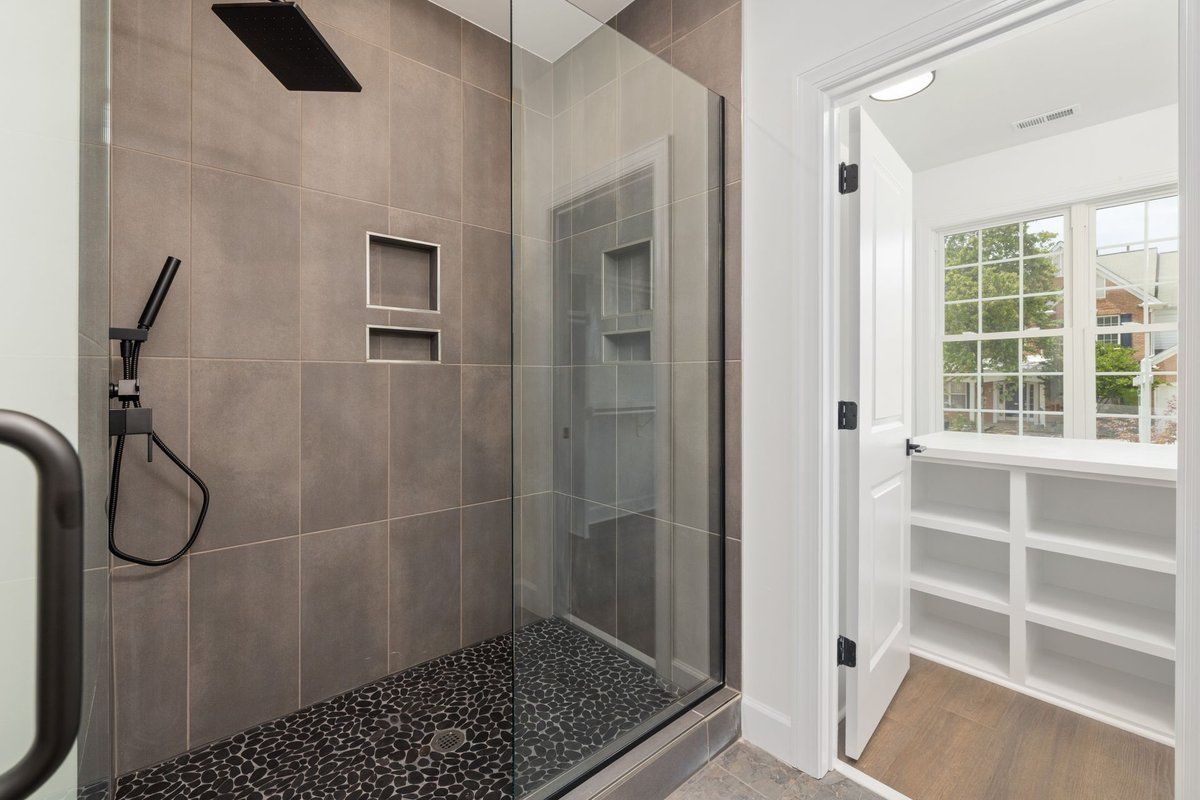
Photo by Curtis Adams on Pexels
Which job types deserve their own page?
Every type of job you do regularly and want more of. Full bathroom refits, wet rooms, walk-in showers, accessible bathrooms, en suites and cloakrooms are separate searches with different needs behind them. A page for each lets you answer those needs properly and gives Google a clear match for each search.
Start with the work that is most profitable or most common for you. Each job type page should explain who it suits, what's involved, how long it typically takes and what the customer needs to decide. Link it to the project pages that show that type of job.
Be honest about scope. If you fit bathrooms that customers have bought elsewhere, say so plainly. If you handle tiling but subcontract electrics, explain how that works. Where electrical or other notifiable work is involved, GOV.UK explains that installers registered with a competent person scheme can self-certify that their work complies with building regulations. If you or your partners are registered, say which scheme.
Job type pages are where SEO for bathroom fitters starts to pay. They are also where the secondary search terms live. If you are researching SEO for bathroom companies, job type pages are a good place to start.
How do you build town pages without creating doorway pages?
Write a town page only where you have real work and something specific to say, such as recent projects nearby, typical housing or how you handle parking and access. Google's spam policies class pages targeted at specific cities that funnel users to one page as doorway abuse. Near-identical pages with the town name swapped are the classic example.
Town pages done well are one of the strongest tools in SEO for bathroom fitters. Thin town pages can look like a shortcut, but copying the tactic is risky for a small business. A better approach is fewer, stronger pages. One good page for each of the three or four towns where you most want work beats twenty thin ones.
A town page that helps should include:
- Two or three project examples from that town, linking to their project pages.
- The job types you do most there.
- Practical notes, such as whether you cover surrounding villages.
- The same phone number and contact details as the rest of your site.
If a town has nothing distinct to say, cover it on a wider area page. Your Business Profile service areas should match the towns you cover on the website, so Google sees the same story in both places.
How should a bathroom fitter write titles, headings and image text?
Say exactly what the page is about, in the words a customer would use. A title like "Wet room installation in March, Cambridgeshire" tells Google and the reader more than "Our services". Each page needs one clear main heading, short subheadings and image alt text that describes what is in the photo.
Google's guidance on title links asks for a unique, descriptive and concise title on each page, and warns against keyword stuffing and boilerplate. Treat the main heading the same way. Avoid stuffing in every town and service; a title crammed with keywords reads badly and doesn't help.
For images, describe the scene: "Walk-in shower with a glass screen and grey large-format tiles". Don't repeat the same alt text on every photo. Rename files before uploading so they describe the image too. Compress large photos so pages load quickly on a phone.
Small details like these add up. They are the unglamorous part of SEO for bathroom fitters, which is why they are easy to skip.

Photo by Bimbim Sindu on Pexels
How do internal links help a small trade website rank?
They show Google which pages matter and how they relate. Linking each project page to its job type and town pages, and back again, creates a clear structure. Google's starter guide says it primarily finds pages through links from pages it has already crawled, and that link text tells users and Google what the linked page is about.
Use descriptive anchor text. "See our wet room installations" tells Google and the reader more than "click here". Keep the main navigation simple, with job types and areas easy to reach, and link to your newest projects from the homepage.
A simple structure for a fitter's site might be:
- Homepage, linking to job types, areas and recent projects.
- Job type pages, each linking to relevant projects and areas.
- Town pages, each linking to projects in that town.
- Project pages, each linking back to its job type and town.
This structure grows naturally as you add projects. Each new job strengthens the pages above it, which is why SEO for bathroom fitters compounds over time.
Which approach suits which kind of bathroom business?
It depends on how you sell. A showroom can rank on product and brand searches, while a fitter wins on installation searches and local proof. Lead-gen sites rank widely but don't do the work. Knowing where you can realistically win stops you competing on the showrooms' terms.
| Business type | Searches it tends to win | Typical website structure | Where an independent can compete |
|---|---|---|---|
| Showroom or retailer | Products, styles, brands, ranges | Product and range pages, store locator | Fitting-only work and project proof |
| National brand | Brand names and big generic searches | Large site with many category pages | Local, named fitter with real reviews |
| Lead-generation site | Trade plus town, quote comparisons | Template pages for every trade and town | Specific project and town pages with first-hand detail |
| Independent bathroom fitter | Installation, job type and town searches | Job type, town and project pages | Depth on each job and area served |
Bathroom fitter marketing works best when you lean into the last row, and SEO for bathroom fitters is how you get there. Be the clearest local answer for fitting a particular type of bathroom, and let the showrooms keep the product searches.
What should a bathroom fitter fix first?
Start with the website pages that match your most valuable work, because they feed both Google search and the Maps pack. Write job type pages first, then project pages for recent jobs, then a small number of town pages. Check your Business Profile matches the website. These steps cost time and attention more than money.
A practical order:
- List the three job types you most want more of and write a page for each.
- Turn your last five to ten finished jobs into project pages with real photos.
- Pick the two or three towns you most want work from and write a page for each.
- Rewrite page titles and main headings so each says what and where.
- Add internal links between projects, job types and towns.
- Check your Business Profile service areas and categories match the site.
If your current website can't support new pages easily, our article on whether a new website is still worth it helps you decide between fixing and rebuilding. If you aren't showing up at all, start with our guide on why a business isn't showing up on Google.
How does CodiePi help bathroom fitters with SEO?
We look at why the calls are going to showrooms and lead-gen sites before suggesting anything. Our free audit checks how your business appears on Google and Maps, which pages are missing and how you compare with local competitors. There is no charge and no obligation, and we won't promise rankings or a set number of jobs.
If you want help, our SEO services cover job type pages, project page templates you can fill in yourself, town pages, titles, image text and internal links. We'll work from your real projects and ask you to check every detail.
CodiePi is based in Doddington, March, Cambridgeshire, and works with trades in Peterborough, across Cambridgeshire and elsewhere in the UK. Book your free audit and we'll show you where your SEO for bathroom fitters stands.
Frequently asked questions
How many project pages does a bathroom fitter need?
There is no fixed number. Start with your last five to ten finished jobs and add each new one as you complete it. Quality matters more than quantity: a page with real photos, the town and a short description of the work is far more useful than many thin pages with a single photo.
Can I rank above showrooms for bathroom searches?
For installation and local searches, often yes, because those searches reward specific, relevant pages and local proof. Showrooms are likely to keep the product and brand searches. Focus on job type, project and town pages that show the work you do, and keep your Business Profile accurate and active.
Are lead-generation sites worth paying for?
That depends on the quality of leads and the terms. Some fitters use them alongside their own website. The risk is relying on them, because you don't own the traffic. Building your own pages means each job you finish adds to something that keeps working for you.
Should I create a page for every town I cover?
No. Only create town pages where you can write something specific, such as projects you have done there. Google's spam policies treat near-identical pages targeted at different cities as doorway abuse. A few strong town pages, plus a wider area page, are safer and more useful.
Is SEO for bathroom companies different from SEO for fitters?
The basics are the same. A bathroom company with a showroom can rank for products and visits as well as installation, and may need a hybrid Business Profile. A fitter working from home relies more on a service-area profile and project pages. Both benefit from clear job type pages.
Sources
- Google Search Central, SEO starter guide: https://developers.google.com/search/docs/fundamentals/seo-starter-guide
- Google Search Central, Spam policies for Google web search: https://developers.google.com/search/docs/essentials/spam-policies
- Google Search Central, Google image SEO best practices: https://developers.google.com/search/docs/appearance/google-images
- Google Search Central, Influencing your title links in search results: https://developers.google.com/search/docs/appearance/title-link
- Google Business Profile Help, Tips to improve your local ranking on Google: https://support.google.com/business/answer/7091?hl=en-GB
- GOV.UK, Building regulations approval: Use a competent person scheme: https://www.gov.uk/building-regulations-approval/use-a-competent-person-scheme